
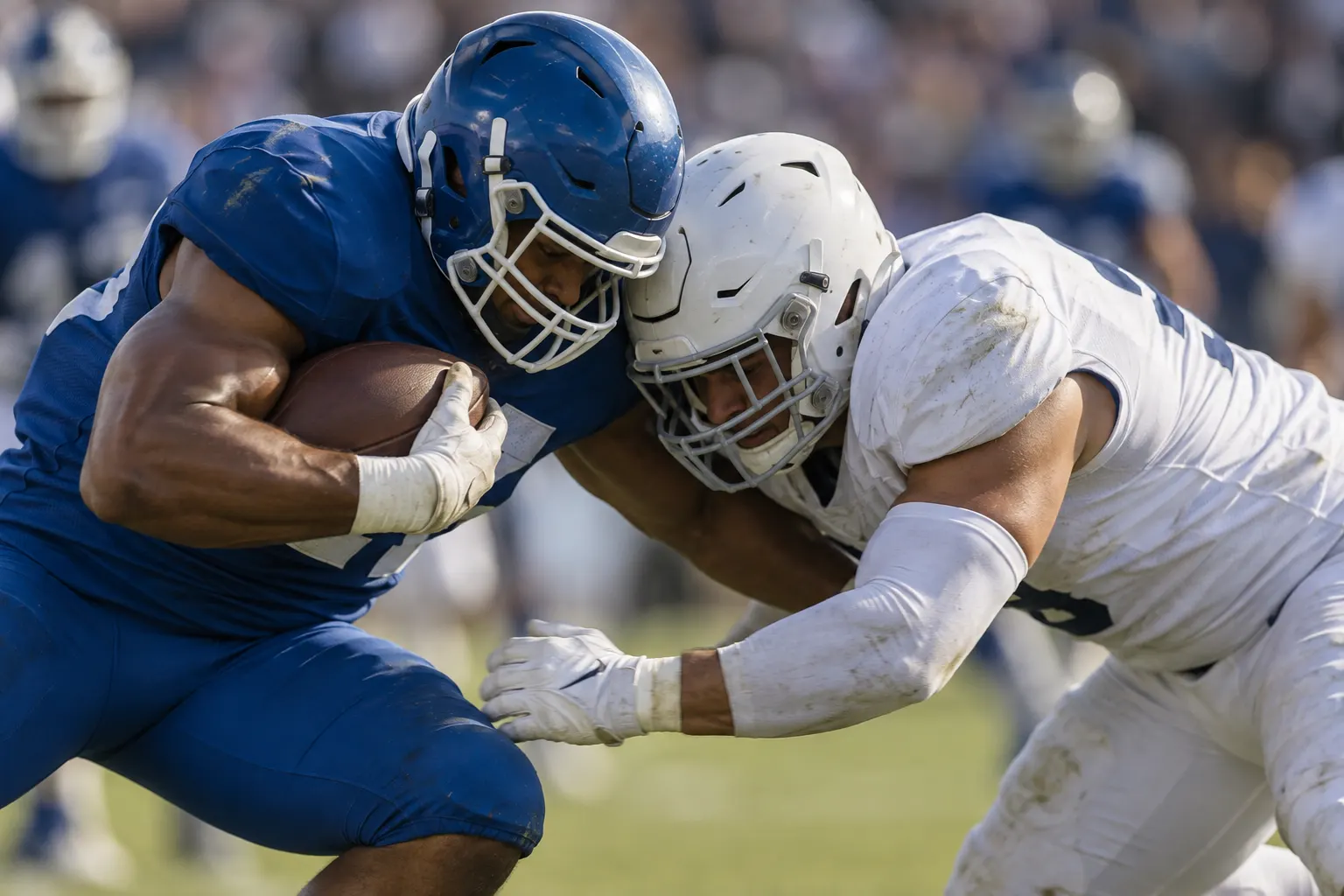
Head impacts can affect more than how an athlete feels.
High-impact sports can expose athletes to repeated concussive and subconcussive head impacts. In his overview of chronic traumatic brain injury, Holden MacRae, PhD, Professor of Sports Medicine at Pepperdine University, identifies prolonged exposure to these impacts as a major risk factor for lasting neurological difficulties. [1, 3, 6, 7]
The effects can involve thinking, behavior, mood, and neurological function. The document describes a variable pattern of symptoms rather than a predictable sequence of stages. That variability makes understanding the individual athlete’s brain an important part of the discussion. [3–5]
Looking at brain activity and connectivity.
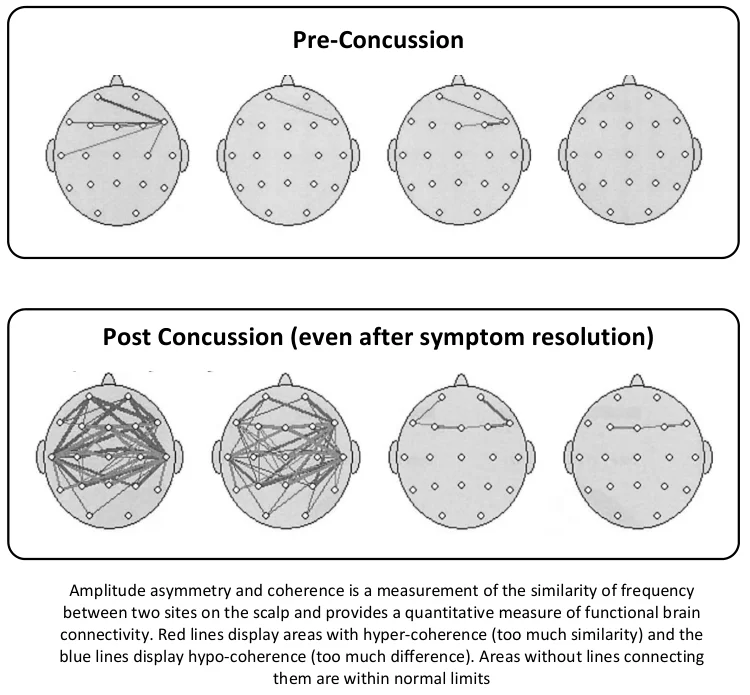
qEEG brain mapping offers a quantitative way to examine patterns of brain activity. MacRae’s document highlights amplitude asymmetry and coherence as measures used to describe functional brain connectivity, looking at relationships between recordings from different scalp locations.
Its illustrations compare pre-concussion maps with post-concussion maps, including a comparison labeled as occurring after symptoms had resolved. The example draws attention to a meaningful distinction: reported symptom improvement and measured brain activity are different sources of information.
The connectivity illustrations use red lines to indicate hypercoherence, or greater similarity, and blue lines to indicate hypocoherence, or greater difference. Connections without lines are described as falling within normal limits. These comparisons illustrate how qEEG can add measurable information to the picture of brain function following head impact.
Research supporting qEEG in traumatic brain injury.
MacRae cites research by Thatcher and colleagues that used a statistical classification method to distinguish traumatic brain injury patients from a normative comparison group in independent samples. The document reports sensitivity of 95.4% and specificity of 97.4% for that research analysis. [8]
These figures refer to the particular research findings summarized in the document. They should not be read as a guaranteed accuracy rate for every brain map or every concussion assessment. The research nevertheless provides support for examining quantitative EEG patterns when investigating the effects of traumatic brain injury.
Connecting measurement with individualized training.
The document also discusses qEEG-directed neurofeedback for post-concussive difficulties. It cites a review by Duff and colleagues in support of continued use of this approach for post-concussive syndrome. [11]
MacRae describes neurofeedback research addressing concerns such as poor concentration, irritability, headaches, anxiety, and depression, alongside dysregulated EEG activity. In this approach, qEEG provides information about the brain activity being considered, while neurofeedback is the training component.
The central case for qEEG in this document is objective measurement: looking at brain activity and connectivity can help deepen understanding of the individual patterns associated with head injury. For athletes exposed to repeated impacts, the document presents brain mapping as a useful part of understanding brain function and considering individualized support.
Source: Holden MacRae, PhD. High Impact Sports and Risk of Chronic Traumatic Brain Injury: Role of qEEG Brain Mapping and Performance Neurofeedback in Risk Management. This article is based solely on that document.
References
References reproduced from the source document. Some entries are abbreviated or contain incomplete author names in the original.
- Martland HS. Punch drunk. JAMA 1928;19:1103–7.
- Critchley E. Nervous disorders in boxers. Medical Annual 1937:318–20.
- Roberts AH. Brain damage in boxers. London: Pitman Medical and Scientific Publishing Co Ltd, 1969.
- Guterman A, Smith RW. Neurological sequelae of boxing. Sports Med 1987;4:194–210.
- Jordan BD. Chronic traumatic brain injury associated with boxing. Semin Neurol 2000;20:179–85.
- Mendez MF. The neuropsychiatric aspects of boxing. Int J Psychiatry Med 1995;25:249–62.
- Rabadi MH, Jordan BD. The cumulative effect of repetitive concussion in sports. Clin J Sport Med 2001;11:194–8.
- hatcher et al. Electroencephalogr Clin Neurophysiol 73:93–106 1989, Thatcher et al J Neuropsychiatry Clinical Neuroscience 13:77–87, 2001.
- ughes and John. The Journal of Neuropsychiatry and Clinical Neurosciences, 11(2), 190–208, 1999.
- Salazar et al. J Head Trauma Rehabil. Oct;15(5):1081–91, 2000.
- Duff et al. Clinical EEG and Neuroscience. Vol. 35 No. 4, 198–209. 2004.
- Rutgers et al., Am J Neuroradiol, 2008, 29:514–519.
- Evans RW., Neurol Clin 1992;10:815–47.
- McAllister TW., Psychiatr Clin North Am 1992;15:395–413.
- Scheid R, et al., Arch Neurol 2006;63:418–24.
- Fork M., et al., Brain Inj 2005;19:101–08.